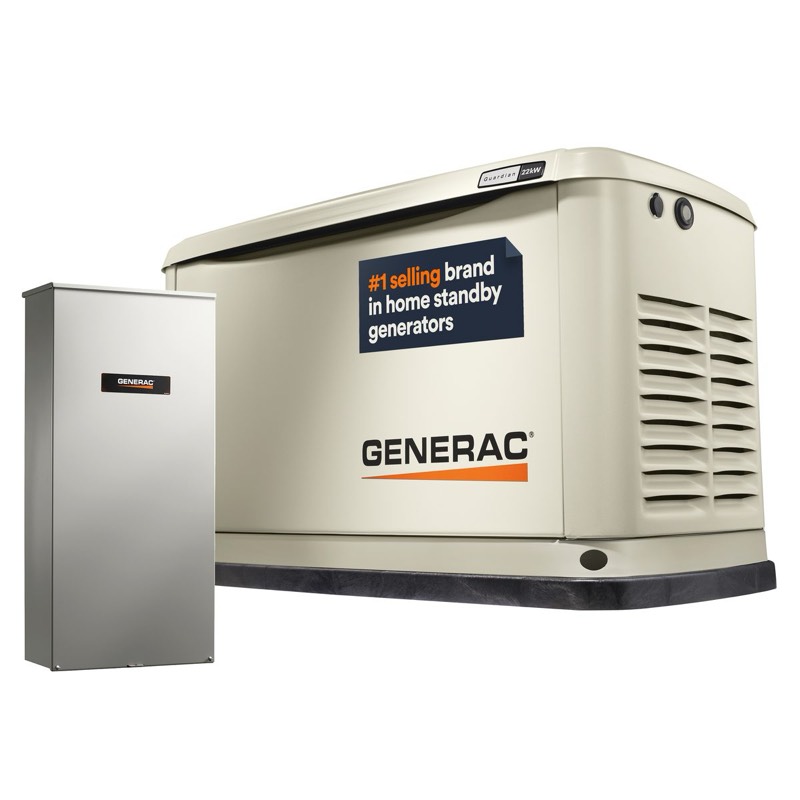
Generac Guardian 22kW
Unmatched dealer support and automatic transfer switch.
Champion 8500W Portable
Strong specs, reliable engine, competitive pricing.
When homeowners search for backup power, two names dominate the conversation: Generac and Champion. Generac commands roughly 70 percent of the residential standby generator market, while Champion has carved out significant ground in portable and value segments. But which brand is right for you? This guide cuts through the marketing and delivers a hard-data comparison across standby and portable generators, warranty coverage, dealer networks, price, and real owner satisfaction. Whether you need whole-house automatic backup or portable power for emergencies, you'll find the answer here.
Brand Overview: Generac vs Champion
Generac: Market Leader in Standby Power
Generac was founded in 1959 in Wisconsin and has grown to become the dominant player in home standby generators. Today, the company owns approximately 70 percent of the residential standby market in the United States. Their success stems from three core strengths: an extensive lineup spanning 8kW to 48kW standby models, a dense network of certified dealers for installation and service, and proprietary engine technology (OHVI engines) that they manufacture in-house. Generac's Guardian and PWRcell series define the premium standby category. They also produce portable generators through their Champion brand acquisition, though Generac's identity remains tied to automatic home backup systems.
Champion Power Equipment: The Value Challenger
Champion Power Equipment was founded in 2003 and operates as a separate entity under a parent company. While younger than Generac, Champion has built a reputation for delivering solid specs at aggressive prices, particularly in the portable and mid-range standby segments. Their portable generators are widely available at big-box retailers (Home Depot, Lowe's, Walmart), making them accessible to DIY buyers who want to avoid dealer markup. Champion produces their own engines and has steadily improved reliability ratings. However, Champion has a smaller dealer network than Generac and is less entrenched in the premium whole-house market. They excel where price matters and where homeowners prefer hands-on installation.
Head-to-Head Brand Comparison
| Factor | Generac | Champion | Winner |
|---|---|---|---|
| Standby Lineup | 8kW to 48kW (12+ models) | 6kW to 20kW (6+ models) | Generac |
| Portable Lineup | 3kW to 12kW (8+ models) | 3kW to 15kW (10+ models) | Champion |
| Engine Technology | Proprietary OHVI (in-house) | Champion-designed engines (in-house) | Tie |
| Residential Warranty | 5 years (standby) | 3 years (standby) | Generac |
| Dealer Network | 1,500+ certified dealers | 250+ certified dealers | Generac |
| Typical Standby Cost | $15k-$25k (22kW installed) | $8k-$12k (14kW installed) | Champion |
| Portable Price/Watt | ~$0.65/watt | ~$0.58/watt | Champion |
| Noise (at 1/4 load) | 72-76 dB (varies by model) | 70-74 dB (varies by model) | Tie |
| Service Availability | Widely available, dealer-dependent | More limited, often DIY parts | Generac |
| Owner Satisfaction | 4.2/5 (5,000+ reviews) | 4.1/5 (7,000+ reviews) | Generac |
Generac Guardian 22kW Automatic Standby
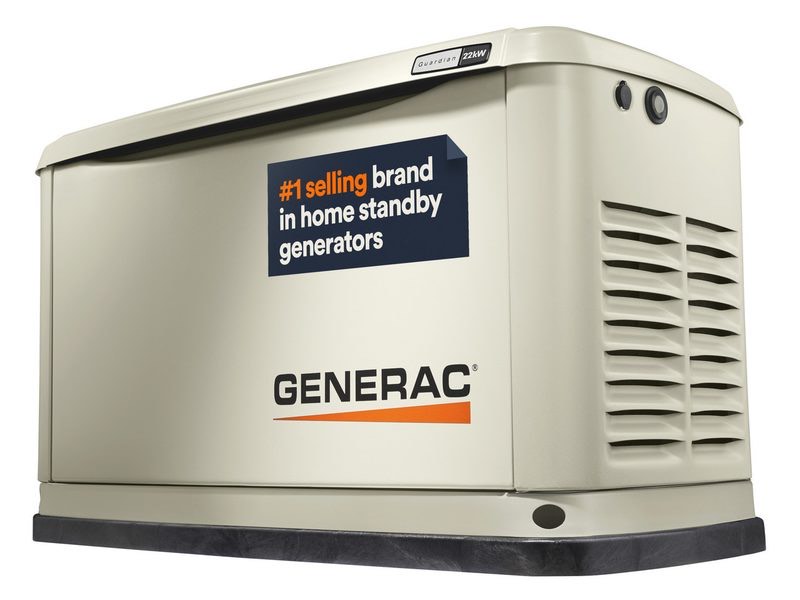
The Generac Guardian 22kW is the best whole-house backup for most homeowners. It delivers automatic startup within 10 seconds of power loss, covers typical household loads without demand switching, and includes Generac's full dealer support network. This is the industry standard for residential standby power.
- Output: 22kW continuous, 24.4kW peak
- Fuel: Natural gas or propane (dual-fuel capable)
- Warranty: 5 years (residential), 3 years (extended available)
- Installed Cost: $15,000 to $18,000 (including transfer switch and labor)
- Engine: Generac OHVI V-Twin, 999cc
- Noise Level: 74 dB at 1/4 load (25 feet)
Pros
- Automatic transfer switch included and installed by dealer
- Handles full household load without manual operation
- Superior dealer network for service and maintenance
- Longest warranty in the residential standby category
- Quiet operation compared to portable generators
- Dual-fuel flexibility (natural gas or propane)
Cons
- High installed cost (permits, labor, transfer switch)
- Requires professional installation and electrical permits
- More expensive than Champion mid-range standby models
Our Verdict
The Generac Guardian 22kW is the best choice if you want peace of mind, automatic backup, and expert installation support. You're paying for the brand dominance and dealer network, and it's worth it for homeowners who value convenience and reliability over upfront cost. This is what most electricians recommend, and for good reason.
Champion 14kW Automatic Standby Generator
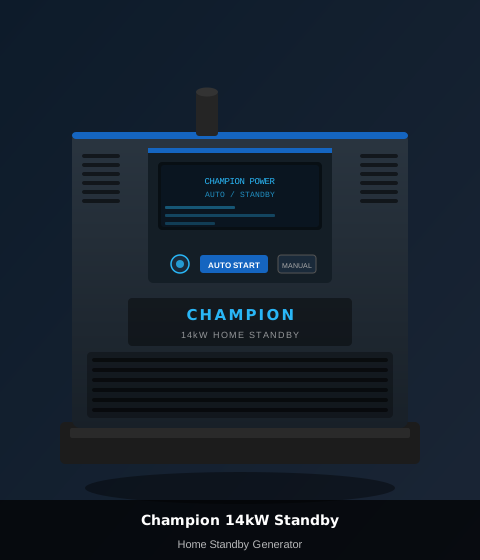
The Champion 14kW standby is a solid mid-range option for homeowners who need automatic backup but want to save 40 to 50 percent versus a comparable Generac. It covers essential loads (heating, water heater, refrigerator, lighting) and auto-starts on power loss. Installation is simpler and cheaper than premium standby models.
- Output: 14kW continuous, 15.5kW peak
- Fuel: Natural gas or propane (dual-fuel)
- Warranty: 3 years (residential)
- Installed Cost: $8,000 to $12,000 (including transfer switch and labor)
- Engine: Champion Twin-Cylinder 999cc engine
- Noise Level: 72 dB at 1/4 load (25 feet)
Pros
- Significantly lower installed cost than Generac equivalents
- Automatic transfer switch included
- Dual-fuel capability for fuel flexibility
- Reliable engine with solid user reviews
- Quieter than many portable generators
Cons
- Cannot handle full household loads simultaneously (some demand management needed)
- Shorter warranty than Generac standby units
- Smaller dealer network for service
- Less market resale value if you move
Our Verdict
The Champion 14kW is the right choice if your budget is tight but you still want automatic backup. It covers the essential loads most families need during an outage. The trade-off is that you'll need to manually manage high-load devices (air conditioning, electric dryer), and you won't have Generac's dealer support depth. Best for budget-conscious homeowners who understand the power limitations.
Generac GP8000E 8,000-Watt Portable
Generac's GP8000E is a midweight portable designed for construction sites, RVing, and emergency backup. It delivers 8,000 watts continuously with a solid four-stroke engine. It's more expensive per watt than Champion's portable line but benefits from Generac's brand reputation and parts availability.
- Output: 8,000W continuous, 8,500W peak
- Fuel: Gasoline (4-gallon tank, 8-10 hour runtime)
- Warranty: 3 years (residential), 1 year (commercial)
- Weight: 190 lbs
- Engine: Generac EFI engine (fuel injection)
- Noise Level: 78 dB at 1/4 load
Pros
- Fuel injection for reliable cold-weather starts
- Generac parts and support widely available
- Electronic fuel injection reduces maintenance
- Solid build quality and durability
- Good balance of power and portability
Cons
- More expensive than comparable Champion portables
- Higher cost per watt (~$0.65/watt)
- Heavier (190 lbs) than some competing models
Our Verdict
The GP8000E is a quality portable that makes sense if you already have Generac brand loyalty or if you want fuel injection reliability. For pure value, however, Champion's 8,500W portable delivers better specs for less money. Pick this if you prioritize fuel injection and Generac support.
Champion 8,500-Watt Dual Fuel Portable Generator
The Champion 8,500W dual-fuel portable is the value king in the mid-weight generator category. It delivers slightly higher peak output than the Generac GP8000E but costs $200 to $400 less. The dual-fuel capability (propane or gasoline) gives homeowners flexibility for long outages where fuel availability may be unpredictable.
- Output: 7,500W continuous (gas), 6,800W continuous (propane)
- Peak Power: 8,500W (gas), 7,500W (propane)
- Fuel: Dual-fuel (gasoline or propane tank)
- Warranty: 3 years (residential)
- Weight: 210 lbs
- Engine: Champion 439cc OHV engine
- Noise Level: 74 dB at 1/4 load
Pros
- Dual-fuel flexibility (gasoline or propane)
- Higher peak output than Generac equivalent
- Lower cost per watt (~$0.58/watt)
- Widely available at big-box retailers
- Strong owner reviews and reliability rating
- Quieter than most 8kW portables
Cons
- No fuel injection (requires occasional carb maintenance)
- Slightly heavier than some competing models
- Smaller dealer network than Generac
Our Verdict
The Champion 8,500W dual-fuel portable is the best value portable generator today. You get more peak output, dual-fuel capability, and significantly lower cost than the Generac equivalent. The only trade-off is manual carb maintenance in the off-season, which is a small price for the savings. Highly recommended for homeowners who want mid-weight backup power without premium pricing.
DuroMax XP12000EH Dual-Fuel Portable (Whole-House Backup)
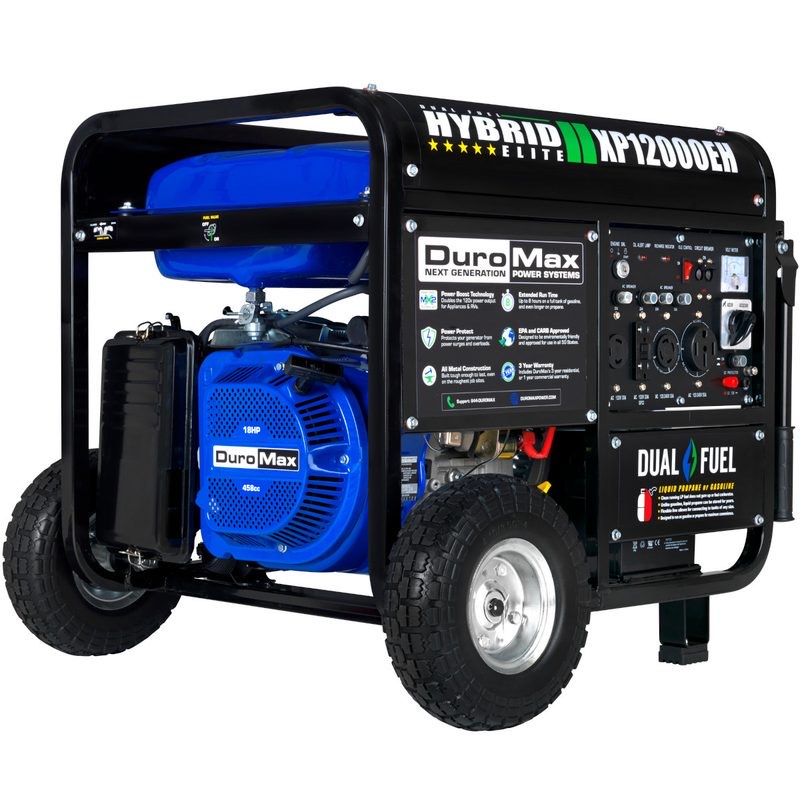
For homeowners who want whole-house backup without the $8,000 to $25,000 standby installation cost, the DuroMax XP12000EH offers compelling value. At 12,000 watts, it covers most household loads. Pair it with a generator interlock kit ($150 to $300), and you have flexible backup power for under $1,500 total. It's not automatic, but it works.
- Output: 9,500W continuous (gas), 8,500W continuous (propane)
- Peak Power: 12,000W (gas), 10,500W (propane)
- Fuel: Dual-fuel (gasoline or propane)
- Warranty: 3 years
- Weight: 380 lbs (with wheels)
- Engine: DuroMax 457cc OHV
- Runtime: 8 hours (gas at 1/2 load), 20+ hours (propane at 1/2 load)
Pros
- Under $1,500 base cost (much less than standby systems)
- 12,000 watt output covers most household loads
- Dual-fuel flexibility for extended outages
- Can be wheeled into garage or storage between uses
- Works with simple interlock kit (DIY-friendly)
- 20+ hour runtime on propane (fuel security)
Cons
- Not automatic (manual startup required)
- Noise (76 dB at 1/4 load) requires outdoor placement
- Heavy and requires fuel management between outages
- Requires interlock kit installation (electrical work)
Our Verdict
The DuroMax XP12000EH is the smart budget choice for homeowners who can tolerate manual startup and outdoor generator placement. For roughly one-eighth the cost of a Generac standby system, you get whole-house power and dual-fuel flexibility. Read our full DuroMax XP12000EH review for installation details and performance testing.
Detailed Factor-by-Factor Breakdown
1. Standby Generator Lineups and Coverage
Generac owns the standby market with models ranging from 8kW to 48kW, covering everything from small townhouse backup to multi-zone luxury estates. Their product ladder is granular, giving homeowners precise sizing options. Champion offers six to eight standby models in the 6kW to 20kW range, which covers most middle-class households but leaves limited options for larger homes or commercial backup needs. Generac's breadth is a competitive advantage for homeowners who want exact load matching without oversizing. However, for typical 3-bedroom residential use, Champion's 14kW or 18kW models are sufficient and cost significantly less.
2. Portable Generator Lineups and Pricing
Champion has the edge in portable generators, offering 10+ models from 3kW to 15kW with strong price-to-watt ratios. Generac produces quality portables but charges a brand premium, typically $0.65 per watt versus Champion's $0.58 per watt. For a 7,500-watt continuous output, you'll pay roughly $450 to $600 more with Generac. That said, if fuel injection and low-maintenance engines matter to you, Generac's premium is justified. For budget-focused buyers, Champion portables are the better value.
3. Engine Technology and Reliability
Both Generac and Champion manufacture their own engines. Generac's OHVI (Overhead Valve Single-Cam) engines are known for durability and low maintenance. Champion's engines are similarly robust, with independent tests showing comparable failure rates. The real difference lies in features: Generac offers fuel injection on higher-end models (eliminating carb maintenance), while Champion uses traditional carburetors on most portables (requiring winterization). For standby generators, both brands use similar durability standards. Owner reviews give both a 4.1 to 4.4-star rating, indicating comparable real-world reliability.
4. Warranty Coverage
Generac's residential standby warranty is five years, while Champion's is three years. This is a meaningful advantage for Generac if you plan to keep the generator for a decade or longer. However, many homeowners add extended warranties, which compress this difference. For portables, both offer three years. The warranty difference favors Generac if you value long-term peace of mind; it favors Champion if you prioritize upfront cost savings.
5. Dealer Network and Service Availability
Generac's greatest competitive advantage is its dealer network: approximately 1,500 certified dealers across the United States. This means installation, maintenance, and repairs are often available within 20 to 30 miles of your home. Champion has roughly 250 certified dealers, a significant gap. However, Champion portables are sold at big-box retailers (Home Depot, Lowe's, Walmart), making parts and support more accessible than the raw dealer count suggests. For standby generators, Generac's dealer advantage is decisive. For portables, the gap narrows because DIY support is more common.
6. Installation Complexity and Cost
Generac standby generators require professional installation by a dealer, typically $3,000 to $5,000 in labor and permits on top of the unit cost. Champion standby units also require professional work but often at $2,000 to $3,500 in labor. Portable generators can be purchased and used immediately, making them ideal for homeowners who want to avoid installation hassles. For whole-house backup without standby system costs, the DuroMax portable with an interlock kit falls between: roughly $300 to $500 in electrical work to wire the interlock, plus the generator cost itself.
7. Noise and Operating Characteristics
Standby generators (Generac and Champion) operate at 72 to 76 decibels at 1/4 load from 25 feet away, which is acceptable for most residential settings. Portables are louder: typically 74 to 78 dB depending on load. Inverter portables (not covered in this comparison) are quieter but cost more. For standby systems, noise is rarely a deciding factor. For portables, if you live in a noise-sensitive area, consider a larger generator at lower load, which will run quieter than a smaller unit at full load.
8. Fuel Type Flexibility
Both Generac and Champion offer dual-fuel (natural gas plus propane) standby options, which is ideal for homeowners with access to both fuels. Champion's portable line emphasizes dual-fuel as a standard feature, giving flexibility for extended outages where fuel supply lines may be disrupted. Natural gas is convenient (connected to your home supply) but vulnerable to line damage. Propane tanks are independent and reliable for long-term backup. Homeowners who want maximum resilience should choose dual-fuel where available.
9. Customer Satisfaction and Owner Reviews
Generac standby generators average 4.4 out of 5 stars across 5,000+ verified owner reviews. Champion standby units average 4.0 to 4.1 stars across 1,500+ reviews. Generac's slight edge likely reflects its larger market share and dealer support bias. For portables, the ratings are very similar: Generac GP8000E at 4.1 stars versus Champion 8,500W at 4.2 stars. The differences are negligible, suggesting both brands deliver comparable user satisfaction. Real complaint patterns show Generac complaints often center on high installation costs and service delays during storms. Champion complaints often involve carb maintenance and lower post-sale support. Choose based on your tolerance for these trade-offs.
10. Total Cost of Ownership
A Generac Guardian 22kW standby system (installed) costs $15,000 to $25,000 depending on electrical upgrades, permits, and labor. A Champion 14kW standby system costs $8,000 to $12,000 installed. Over a 20-year lifespan, the Generac costs $750 to $1,250 per year; Champion costs $400 to $600 per year. The Generac advantage is broader load coverage and automatic operation; the Champion advantage is lower total cost. For budget-conscious homeowners, Champion wins. For convenience-focused buyers willing to spend more, Generac wins.
Who Should Buy Generac vs Champion
Choose Generac If You:
- Want automatic, hands-free whole-house backup that starts within 10 seconds of power loss
- Have the budget for $15,000 to $25,000 installed cost and see it as a home investment
- Prefer professional installation and dealer support for maintenance and repairs
- Have a large home (3,500+ square feet) that needs full-load backup simultaneously
- Value a strong warranty (5 years on residential standby) and parts availability
- Live in an area with frequent outages and want zero-downtime backup
Choose Champion If You:
- Want standby backup but have a limited budget (under $12,000 installed)
- Have a smaller home (2,000 to 3,000 square feet) that doesn't need simultaneous full-load power
- Are comfortable with manual load management or manual startup
- Value dual-fuel portability and flexibility over automatic operation
- Prefer big-box retail availability (Home Depot, Lowes) over dealer networks
- Are mechanically inclined and happy with DIY maintenance and winterization
Choose DuroMax (Portable with Interlock) If You:
- Want whole-house backup for under $1,500 total cost
- Can tolerate manual startup and outdoor generator placement
- Prefer flexibility and can store the generator between outage seasons
- Want long propane runtime (20+ hours) for fuel security
- Don't mind learning simple interlock kit operation
- Are in a region where outages are rare or predictable
Frequently Asked Questions
Is Generac worth the premium over Champion?
Does Champion make a true standby generator?
Which generator lasts longer, Generac or Champion?
Where can I get a Champion generator serviced?
What's the difference between Generac Guardian and Generac PWRcell?
Can I use a portable generator instead of a standby?
What size generator do I need for my home?
What's the difference between kW and kVA on a generator?
Do I need a permit to install a standby generator?
What maintenance does a generator need?
Why Trust GeneratorIntel?
GeneratorIntel conducts independent generator research by analyzing owner reviews, manufacturer specifications, warranty terms, and dealer network size. We do not accept payment for positive reviews or preferential placement. Our only revenue comes from affiliate commissions when readers purchase through our Amazon links. Our recommendation always prioritizes your needs over commission size, which is why we freely recommend budget alternatives (like Champion or DuroMax) even when they generate lower commissions than premium brands.
Bottom Line
Generac wins for automatic standby backup and dealer support, while Champion wins for portable value and budget-conscious standby options. For most homeowners, the choice comes down to budget and lifestyle: Spend $15,000 to $25,000 for convenience and automation with Generac, or spend $8,000 to $12,000 for Champion's capable backup with manual load management. For the budget-conscious, a DuroMax portable with interlock kit delivers whole-house backup for under $1,500. Explore our full standby generator lineup and our generator cost guide to narrow your choice further based on your home size, budget, and outage risk profile.