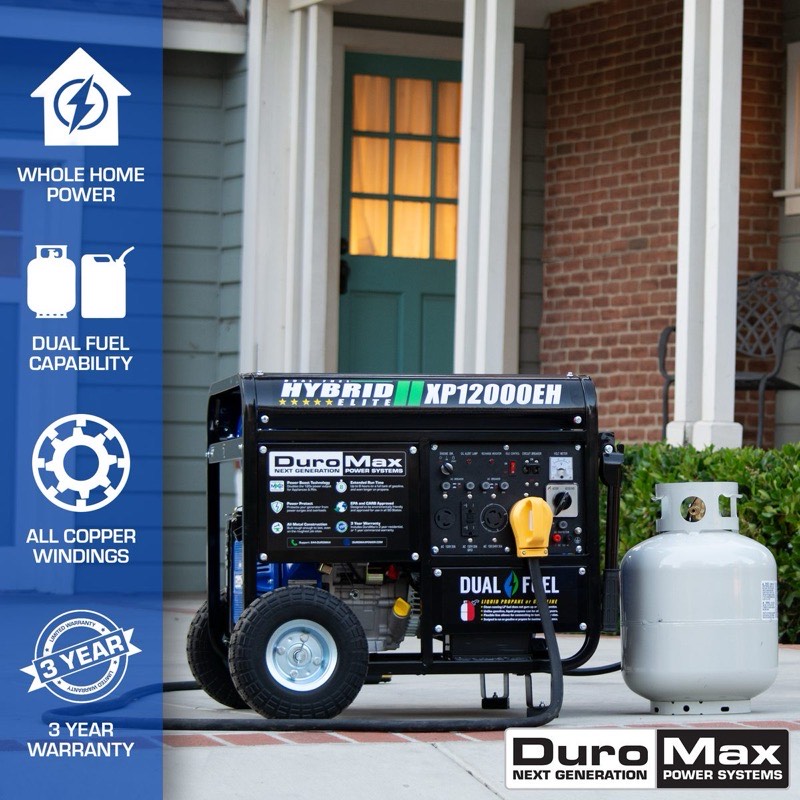
A whole house standby generator installed by a licensed contractor runs $10,000 to $15,000 or more by the time you account for the unit, the automatic transfer switch, the gas line, the permits, and the labor. That number stopped me cold. I needed reliable backup power for my home, not a second mortgage payment. So I bought the DuroMax XP12000EH instead, had an electrician install an interlock kit on my panel, and have been running it as my primary whole-house backup for over a year now. This review covers what I actually found: the honest load math, the maintenance reality, the noise, and who this machine makes sense for.
DuroMax XP12000EH: Quick Specs
DuroMax XP12000EH 12,000-Watt Dual Fuel Portable Generator
The XP12000EH is a full-output dual fuel generator built for homeowners who want real whole-house capacity without a permanent standby installation. It delivers 9,500 running watts on gasoline, runs on gas or propane, includes electric start, and connects directly to your home's panel via a properly installed interlock kit. It is not automatic, not quiet at full load, and not a set-it-and-forget-it appliance. It is, however, one of the most capable and affordable whole-house portable generators on the market.
- Peak Wattage (Gas): 12,000 watts
- Running Wattage (Gas): 9,500 watts
- Peak Wattage (Propane): 11,400 watts
- Running Wattage (Propane): 9,025 watts
- Fuel: Dual fuel (gasoline or liquid propane)
- Start: Electric start (key) + recoil pull-start backup
- Engine: DuroMax 457cc 18HP OHV
- Fuel Tank: 8.3 gallons (gasoline)
- Runtime at 25% Load (Gas): Up to 19 hours
- Runtime at 50% Load (Gas): Approximately 8 hours
- Noise Level: 74 dBA (manufacturer spec at 25% load); 88-90 dBA at full load
- Outlets: (2) 120V 20A duplex, (1) 120V 30A L5-30R, (1) 120/240V 30A L14-30R, (1) 120/240V 50A 14-50R, (1) 12V DC
- Weight: 224 lbs (assembled)
- Dimensions: 29" L x 30" W x 26" H
- Transfer Switch Ready: Yes (L14-30R twist-lock and 14-50R 50A outlet)
- Warranty: 3 years residential (DuroMax)
- Amazon Price: Check current price below
Who This Generator Is For (and Who It Is Not)
This is not a generator for everyone, and I would rather tell you that upfront than have you spend $1,400 on something that does not fit your situation. Here is a direct breakdown.
This generator is a good fit if:
Homes in this range typically run well within the 9,500W continuous output limit, even with central AC running.
An interlock kit and a generator inlet box let you connect this machine to your panel legally and safely, without gas lines or a concrete pad.
There is no automatic transfer switch here. When the power goes out, you go get the generator. If you are comfortable with that, it is not a dealbreaker.
A 3,500W or 5,000W generator is not going to run your central AC and your well pump at the same time. This one will.
This generator is not the right fit if:
You want power to come back on automatically when you lose the grid. If that is your priority, an automatic standby generator with a transfer switch is the correct solution. If you travel frequently or are not home to start the generator during an outage, the manual transfer process becomes a real problem. Similarly, if your home runs two large HVAC systems or has a heavy commercial electrical load, the 9,500W ceiling may not be enough. For most residential homeowners with a single-zone HVAC system, it is plenty.
What 9,500 Running Watts Actually Powers
The most common question about this generator is whether 9,500 watts is truly enough for a whole house. The answer depends on what is actually pulling power in your home. Here is a realistic load calculation based on common residential appliances.
| Appliance | Typical Running Watts | Notes |
|---|---|---|
| Central AC, 3-ton unit | 3,500W | Starting surge can hit 7,000-9,000W briefly; use a soft start device if needed |
| Well pump, 1HP | 2,000W | Starting surge up to 3,500W; stagger starts to stay within peak rating |
| Refrigerator | 800W | Cycles on and off; average draw is actually lower |
| Chest freezer | 500W | Efficient modern units may draw even less |
| LED lighting, whole house | 500W | Modern LED loads are very low; 500W is conservative |
| Miscellaneous (TV, phones, fans, outlets) | 1,000W | Laptops, TVs, phone chargers, box fans, etc. |
| Total Typical Load | 8,300W | Comfortably within 9,500W running limit |
That 8,300-watt figure leaves approximately 1,200 watts of headroom, which is meaningful. You can run a sump pump when it kicks on, charge power tools, or power a second refrigerator without tripping the generator's overload protection. What you cannot do is run an electric dryer (5,000-6,000W), an electric range (7,000-10,000W), or multiple large HVAC systems at once. Plan around those load limits and this machine handles everything else without complaint.
One important note on starting watts: large motor loads like AC units and well pumps draw 2 to 3 times their running wattage for a fraction of a second on startup. The XP12000EH's 12,000-watt peak rating handles these surge loads. If you have an older or oversized AC unit with a high starting draw, a soft-start capacitor kit (such as the MicroAir EasyStart) can reduce the startup surge significantly and give you more comfortable headroom.
The Interlock Kit Setup: How to Do This Right
The interlock kit is how this portable generator becomes a legitimate whole-house backup system without the cost of a standby installation. Understanding how it works and what it requires is important before you commit to this approach.
What an interlock kit does
An interlock kit is a metal slide or bracket that mounts directly to your existing electrical panel. Its purpose is simple and critical: it physically prevents the main utility breaker and the generator input breaker from being switched on at the same time. This eliminates backfeed, which is the dangerous condition where generator power flows backward into the utility grid and can electrocute lineworkers restoring power. Interlock kits meet NEC 702.4 standards and are legal for use across the United States when properly installed. Manufacturers like Siemens, Square D (Schneider), and third-party specialists like Interlockkit.com and GenInterlock.com make panel-specific kits designed to fit the exact breaker box in your home.
What the setup requires
The interlock kit itself typically costs $50 to $200 depending on your panel brand and the kit manufacturer. You will also need a generator inlet box mounted on the exterior of your home, and a heavy-duty generator cord to connect the XP12000EH to that inlet. Electrician labor, a permit in most jurisdictions, and any conduit or wiring runs add to the total. In most parts of the country, budget $300 to $800 for the complete installation. In higher-cost markets or with more complex panel setups, quotes can run higher.
This is not a DIY project. Work with a licensed electrician. They will pull the permit, size the inlet correctly for the generator's 50-amp output, match the interlock kit to your specific panel model, and ensure the installation passes inspection. The cost is real but small relative to the price of a full standby installation, and it gives you a code-compliant, safe connection point for this generator or any future generator you own.
The DuroMax XP12000EH's connection options
The XP12000EH includes a 120/240V 50A outlet (NEMA 14-50R) and a 120/240V 30A twist-lock outlet (L14-30R), both of which are standard connection points for whole-house interlock setups. Your electrician will specify which inlet box and cord to use based on how your panel is configured. In most residential setups, the 30A L14-30R connection handles the transfer load, but the 50A outlet gives you more flexibility for high-draw configurations.
Real Owner Experience: One Year In
I have been through several power outages with this machine since the interlock was installed. Some lasted a few hours, one stretched past 30 hours. Here is what I actually found.
What Works Well
- It starts reliably. Electric start fires on the first key turn in both warm and cold weather. The recoil backup has never been needed, but it is there if the battery ever fails.
- Dual fuel is genuinely useful. Running out of gasoline during a prolonged outage is a real concern. Having the option to switch to a propane tank already on the property adds a meaningful layer of resilience.
- True whole-house capacity. AC runs. Well pump runs. Refrigerator, freezer, lights, all of it. This is not a triage situation where you pick and choose what gets power.
- The 50A outlet is a serious connection. This is not a generator you cord directly into a single appliance. The panel connection via interlock means the whole house electrical system is live, exactly as it would be on utility power.
- Build quality is solid. The frame is heavy steel. The panel is well-organized. The wheel kit handles the weight reasonably well on flat ground.
- Price relative to output. At its typical street price, this is substantially less expensive per watt than most comparable generators from Generac, Westinghouse, or Champion at the same output tier.
What You Need to Accept
- Manual transfer is a real process. When the grid drops, you have to go out and start the generator. In a winter storm at 2 AM, that is less pleasant than it sounds. There is no getting around it with this setup.
- Full-load noise is significant. The manufacturer's 74 dBA spec is measured at 25% load. At full load, real-world testing puts it at 88 to 90 dBA. That is loud. You will hear it clearly from inside the house, and your neighbors will too.
- No oil filter means frequent oil changes. The 457cc engine has no oil filter on the factory unit. DuroMax recommends changing oil every 20 to 25 hours on conventional oil, or every 30 hours on synthetic. During a multi-day outage, plan for at least one oil change.
- 224 pounds requires planning. Storage, movement, and access all require some forethought. A generator storage shed or covered area near the connection point makes a significant difference.
- THD is not inverter-grade. The XP12000EH has a total harmonic distortion rating of less than 12%. Sensitive electronics like certain medical equipment or high-end audio gear may not appreciate that. For most household use, it is fine.
Maintenance Reality: What This Machine Actually Requires
A generator that sits in a shed for 11 months and then refuses to start when you need it is worse than no generator at all. The XP12000EH is not a maintenance-free appliance. Here is the honest picture of what keeping it ready requires.
Oil and oil changes
DuroMax specifies 10W-30 motor oil for most operating conditions. After the initial break-in period (typically the first 5 to 10 hours with a dedicated break-in change), the ongoing interval is every 20 to 25 hours on conventional oil or every 30 hours on synthetic. Many experienced owners run full synthetic such as Mobil 1 10W-30 or 5W-40 and push intervals to 40 to 50 hours based on oil analysis results from services like Blackstone Labs. The engine holds approximately 1.1 quarts. Because there is no oil filter, changing oil more frequently is the machine's way of keeping the engine clean. Keep at least one quart of oil on hand whenever you run the generator for extended periods.
Air filter
Inspect the foam pre-filter every 25 hours and clean or replace it as needed. In dusty environments, check it more often. A clogged air filter reduces power output and strains the engine. Replacement filters are inexpensive and widely available.
Fuel storage and stabilizer
Gasoline starts to degrade in as little as 30 days, and ethanol-blended fuel can cause carburetor deposits and gumming in as few as 60 days. If your generator sits in storage between outages (and most do), you have two good options: run it dry of gasoline before storage, or treat the tank with a quality fuel stabilizer such as STA-BIL or PRI-G before topping it off. Run the generator for 10 minutes after adding stabilizer to ensure treated fuel reaches the carburetor. The propane side has no degradation concern, which is one of the practical arguments for keeping a propane tank connected as your storage-ready fuel.
Monthly exercise run
Run the generator under load for 30 minutes each month. This keeps the battery charged, prevents fuel varnishing in the carburetor, circulates the oil, and verifies the machine will start when you actually need it. Load it with at least 50% of its rated capacity during the exercise run. Idling unloaded for extended periods accelerates engine wear and carburetor buildup.
Propane connections
Inspect the propane hose and fittings before each use. Look for cracks, brittleness, or any sign of damage. Propane hoses have a recommended service life and should be replaced on schedule regardless of apparent condition. Use a leak detector solution or soapy water on all connections before starting on propane, especially after the generator has been in storage.
Propane vs Gas: Which to Use
The dual fuel capability is one of the main reasons to choose this machine over a single-fuel alternative. But propane and gasoline have meaningfully different performance profiles on this unit, and the right choice depends on your situation.
Gasoline: the high-output choice
On gasoline, the XP12000EH delivers its rated 9,500 running watts and 12,000 peak watts. Runtime is approximately 8 hours at 50% load on a full 8.3-gallon tank, or up to 19 hours at 25% load. Gasoline is widely available, and during an outage that affects a small geographic area, you can typically refuel from a nearby station or a stored supply. The downsides: gasoline degrades in storage, it is flammable, and ethanol-blended pump gas can cause carburetor issues in equipment that sits idle for months.
Propane: the storage-ready choice
On propane, output drops to 9,025 running watts and 11,400 peak watts. That is a reduction of about 5 percent on running power and about 5 percent on peak. For most whole-house loads, you will not notice the difference. What propane offers in exchange is indefinite fuel shelf life, cleaner combustion, and the convenience of a tank that is already on the property if you heat with propane or own an outdoor grill setup. A 100-gallon propane tank provides substantially more runtime than the 8.3-gallon gasoline tank, which makes propane appealing for extended outages. If you do not have propane infrastructure at your home, the logistics of borrowing or renting a large tank offset most of the convenience advantage.
The practical answer
Keep the gasoline tank full with stabilized fuel for immediate-use readiness. If your outage extends beyond 24 hours and you have propane available, switching to propane preserves your gasoline supply and reduces trips to the fuel station. Having both options available means a regional fuel shortage during a major weather event is far less likely to leave you powerless.
Want exact numbers for your situation? Run your load and tank size through our free generator fuel cost calculator to compare gasoline vs propane cost per hour.
How It Compares to a Standby Generator
This is the honest comparison I wish I had found before I started researching. The DuroMax XP12000EH is not a standby generator, and pretending otherwise would be doing you a disservice. Here is what you gain and what you give up.
| Factor | DuroMax XP12000EH + Interlock | Standby Generator (e.g., Generac 22kW) |
|---|---|---|
| Total installed cost | $1,400-$2,200 (generator + interlock + inlet) | $10,000-$15,000+ installed with transfer switch |
| Transfer to backup power | Manual; 5 to 10 minutes | Automatic; typically 10 to 30 seconds |
| Fuel source | Gasoline or propane (portable tanks) | Natural gas or propane (permanent line) |
| Fuel storage limit | 8.3 gallons gas or size of propane tank on hand | Unlimited (utility gas line) |
| Running watts | 9,500W (gas) / 9,025W (propane) | Typically 18,000-22,000W for whole-house units |
| Monitoring | None; requires owner presence | Remote monitoring, automatic self-test |
| Noise | 74-90 dBA depending on load | Enclosed units are typically 60-67 dBA |
| Portability | Yes; can be taken to another property | No; permanently installed |
| Maintenance | Owner-managed; oil changes every 20-50 hrs | Annual professional service recommended |
Who should step up to a standby unit
If someone in your household has a medical condition that depends on continuous, uninterrupted power, a standby generator is the right call. The 5-to-10-minute manual transfer window is not acceptable when someone needs a CPAP machine or medical equipment running at all times. Similarly, if you travel frequently and may not be home when an outage hits, automatic transfer is not a luxury. If you simply want a set-it-and-forget-it system where power comes back on in seconds with no action on your part, budget for a standby installation. The DuroMax XP12000EH is the right answer for homeowners who are present, engaged, and willing to make the manual process work in exchange for $8,000 to $12,000 in savings.
Our Verdict
Bottom Line
The DuroMax XP12000EH delivers on its core promise: genuine whole-house power from a portable generator at a fraction of the cost of a standby installation. The dual fuel capability, reliable electric start, 50-amp panel connection, and 9,500 running watts make it a serious tool for homeowners who want real backup capability without a five-figure commitment. The tradeoffs are real: it is loud at full load, it requires active management during an outage, and the oil change interval is aggressive. If you understand those tradeoffs and they work for your situation, this is an outstanding value. For homes under 2,500 square feet with a properly installed interlock kit, it has been our dependable whole-house backup for over a year and we would buy it again.
Also worth considering: the DuroMax XP12000HX is the updated variant that adds a built-in CO Alert carbon monoxide sensor, which automatically shuts the unit down if dangerous CO levels are detected near the generator. The core power specs are identical. If you are buying new today, compare prices between the EH and the HX before deciding.
Frequently Asked Questions
Can the DuroMax XP12000EH power a whole house?
What fuel is better for the DuroMax XP12000EH, gas or propane?
Is an interlock kit legal and safe for connecting a generator to your home?
How often does the DuroMax XP12000EH need an oil change?
What is the difference between the DuroMax XP12000EH and the XP12000HX?
Why Trust GeneratorIntel?
This review is based on over a year of real-world use of the DuroMax XP12000EH as a whole-house backup generator, supplemented by research from owner forums, independent test data, Reddit discussions from the r/Generator community, and manufacturer specifications. We do not accept free products or paid placement. Our affiliate relationship with Amazon means we earn a small commission if you buy through our links, which costs you nothing and helps fund independent coverage.
Bottom Line
If you want genuine whole-house backup power without a $10,000-plus standby installation, the DuroMax XP12000EH is one of the strongest options available at its price point. It is loud, heavy, requires active management, and demands regular maintenance. It is also reliable, dual-fuel capable, panel-ready with an interlock kit, and priced well below any comparable standby solution. For homes under 2,500 square feet with a properly installed interlock kit and a homeowner willing to manage the manual transfer process, this machine does exactly what it promises. Check the current price on Amazon below, and compare it against the newer XP12000HX if the CO Alert feature matters to you.